


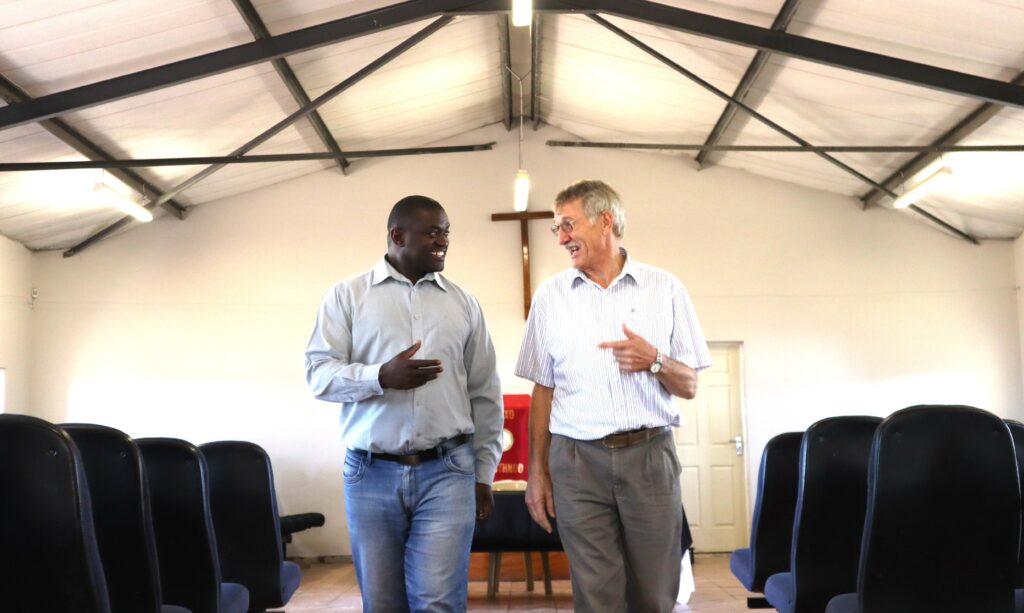
“The church is missional. Wherever it is located, it must show its Godly nature,” says the newly ordained Reverend Msawenkosi Ntshongwana to Heléne Meissenheimer during a recent visit to find out how this former policeman came to be the first black Xhosa-speaking minister of this small English-speaking congregation of the Uniting Reformed Church of South Africa (URCSA) in Vredenburg on the West Coast.
This was quite an historic event in the 70 odd year history of the congregation. Since the Dutch Reformed Church began this ministry in the 1950’s as a missionary outreach, they have always had a white minister, explains Ntshongwana’s predecessor, the 63 year-old Rev Kobus van Schalkwyk during Kerkbode’s visit.
It is a clear sunny morning. Through the living room window one can see the iron ore pink-tainted brick wall of the church hall where, a few months ago, on April 1st, Ntshongwana was ordained. (Incidentally, each of the last three ministers at this congregation had Kobus as their first name. Now Rev Msawenkosi takes his place).
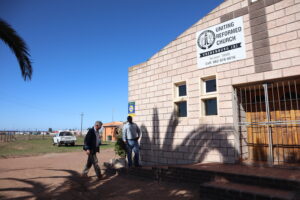
Ntshongwana (35) serves us coffee and biscuits in the bright orange manse in Ongegund, a poorer residential area on the eastern border of Vredenburg, a sprawling town surrounded by brown ploughed fields. The industrial harbour town of Saldanha lies just about 12 km to the south. Cape Town is an hour and a half’s drive away.
Ntshongwana calls Van Schalkwyk ‘mfundisi’, the Xhosa word for minister. It is clear to see that the two have a comfortable relationship. They converse in isiXhosa, the language that both grew up with in the Eastern Cape. In fact, Van Schalkwyk says he spoke isiXhosa before he learnt Afrikaans from his parents on their farm in the former Ciskei homeland.
Van Schalkwyk came to Vredenburg in around 2008 as the new URCSA minister after 18 years working as a missionary in northern KwaZulu-Natal. He lives in the town and intends to stay on in a supportive role until his retirement in less than two years’ time. His eyes light up in excitement when he talks about this decision of the local URCSA’s church council that the time is right “for them to move on” to have their own minister, even though this means the congregation of around 100 members has to now, for the first time, take responsibility for his remuneration. Previously a few of the local DRC congregations and the DRC’s Witness Ministry provided this financial support.
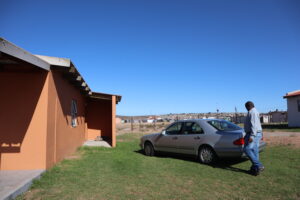
So far, things have gone well, according to the two ministers. The congregation even surprised Ntshongwana at his ordination with a second hand car to use as transport to the three wards of the congregation. Most live in Vredenburg, but there are also some members living in nearby Saldanha as well as a small group in Citrusdal, about 133 km from here.
Keeping hope alive for church unity
As a former policeman, Ntshongwana likes to keep fit. The topic of church unity, or rather the lack of it, had come up earlier while we were waiting for him to come back from his thrice weekly session at the gym.
Van Schalkwyk had told Kerkbode how sad he was that some years ago four of the seven Dutch Reformed churches in the local Presbytery voted against unification with their sister churches in the Uniting Reformed Church of South Africa (URCSA).
He firmly believes that this vote reflects a minority voice and that most members have no problem with unity, but unfortunately most didn’t vote. So, consequently, “the message the URCSA received was that the answer to unification is no …” which was a serious setback to their goal of unification.
When asked for his view on this topic, Ntshongwana said his experience in the URCSA is that language preferences are also a factor. “… when it comes to unity, without speaking about the DRC and URCSA, we are still struggling as URCSA … the Xhosa speaking and Afrikaans speaking,” says Ntshongwana, who now finds himself living in an area where almost 70% of the residents are Afrikaans speaking. Locals often joke that they only speak English in self-defence.
Less than a kilometre from him is the church of the Afrikaans branch of the URCSA.
Yet here he is … “Unity is very difficult … I foresee no unity as long as we don’t want to leave our own comfort zones,” he says, but it is his dream that it could become a reality, however tough.
‘I almost stayed behind’
Ntshongwana knows something about getting through tough times. It took him a full year, seven years ago, to make the decision to study theology full time, because this meant he would give up the steady income he earned working as a policeman in Kokstad in the Eastern Cape. Not an easy decision to make as he was the only breadwinner in the family, yet his grandmother, to whom he was very close as she is the one who raised him, told him she would not stand in his way.
At the beginning of 2015, he arrived on a Sunday in Stellenbosch under the misconception that the Dutch Reformed Church would provide housing and pay for his studies. He soon realised this was a mistake. The very next day his grandmother died and he had to go back to the Eastern Cape for her funeral.
“I almost stayed behind. I was demotivated, but my grandfather said go …”
So, he came back with no place to stay and no bursary, but he persevered. After all his name (Msawenkosi) means ‘grace of God’. “I am carrying the grace of God wherever I go,” he explains. A few bursaries later he not only completed his honours degree but is currently continuing with studies for a Master’s degree in Theology, also from Stellenbosch University.
“Hier is ek,” he says in Afrikaans and smiles.
Going forward he knows he will need a lot of grace in his first ministry. At night he sometimes hears gunshots from the shack settlement next to the manse and the church hall. There is a lot of crime, drug abuse and poverty in the area.
Yet it is exactly in an area such as this where Ntshongwana believes the church must be most visible. “The church is missional. Wherever it is located, it must show its Godly nature … the question the church should ask is, what would God do in a situation like this?”
The former policeman believes the church should work hand in hand with local role players like the police service, social development and others to bring about a better community.
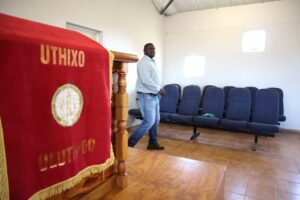
“I like what I hear … I like that he has a vision for a missional church,” confides Van Schalkwyk to Kerkbode later when Ntshongwana shows us their church hall with its plush slightly worn cinema seats, a donation after the town’s only cinema closed down more than a decade ago.
In front is the pulpit with the isiXhosa words “uthixo uluthando” (God is love) written on it’s red pulpit cloth.