



The Dutch Reformed Church (DRC) might be recovering from the nosedive that at one point saw this 374 year old denomination having to close permanent positions for ministers at a rate of roughly 50 per year.
“From 2015 to 2022 I think we lost nearly 33% of permanent positions,” says dr Lourens Bosman, a member of the DRC’s multi-faculty research task team who report to the General Synod. “… and then we started seeing a slowing down of that trend.”
Bosman says: “There are of course different reasons … and one has to look very carefully at why (it’s happening).”
LEES OOK: Kerkspieël 2026 onthul die stippellyne wat gemeentes sélf moet trek
The veteran pollster and retired minister from Pretoria spoke to members of the church media about research more broadly during a launch event for the latest Church Mirror survey (Kerkspieël). “We know what the data says, but what does it mean?” he quipped and hinted to the fact that the data coming out of the church is dividing researchers: (Prof) Cobus (van Wyngaard) would keep telling me, Lourens it’s too early to call, it’s not a trend yet … But now we are starting to see that sharp decline slowing down … It feels like we are through the turmoil and there is new stability.”
On the whole, Church Mirror 2026 builds on a tradition spanning nearly four decades of aiming to provide trustworthy and quantitative grounding to some of the key questions a faith community is grappling with. It does a workmanlike job of painting a picture of the church “as is” but this year it exudes a measuredness and even caution around its own findings that stand in contrast to so many consumer surveys and political polls that are invested in their outcomes containing overpowering relevance to the reader and, to the media, breaking news.
LEES OOK: Kerkspieël 2026: Ses tendense uit jongste kerklike opname
While the DRC has had its fair share of entrenched debates over the years, church statisticians like Bosman and prof Kobus Schoeman, from the University of the Free State warn against the blurring of the line between correlation and causation when looking at data. To properly understand what might be construed as a mass exodus of ministers from the church, you have to bring into account the events following 1974, researchers often explain. That year was “peak NG Kerk” from a youth evangelisation point of view. Mass events lead to record numbers of Afrikaner students entering DRC seminaries and it rippled through the system like a Calvinist version of a Mexican Wave. By 1981 a total of 180 ministers were ordained into the church. That is up from 112 students in 1979 and a number never to be seen again. These dominees have now been reaching retirement age and leaving in their wake a very different NG Kerk: Smaller, further from power, and theologically healthier, as journalist Neels Jackson summarised the outcome of events during 1990-2020 in his book Drie dekades van verandering (Three decades of change).
LEES OOK: Kerkspieël 2026: ‘Kleiner is nie (altyd) sterwend’ – NG Kerk in Zim
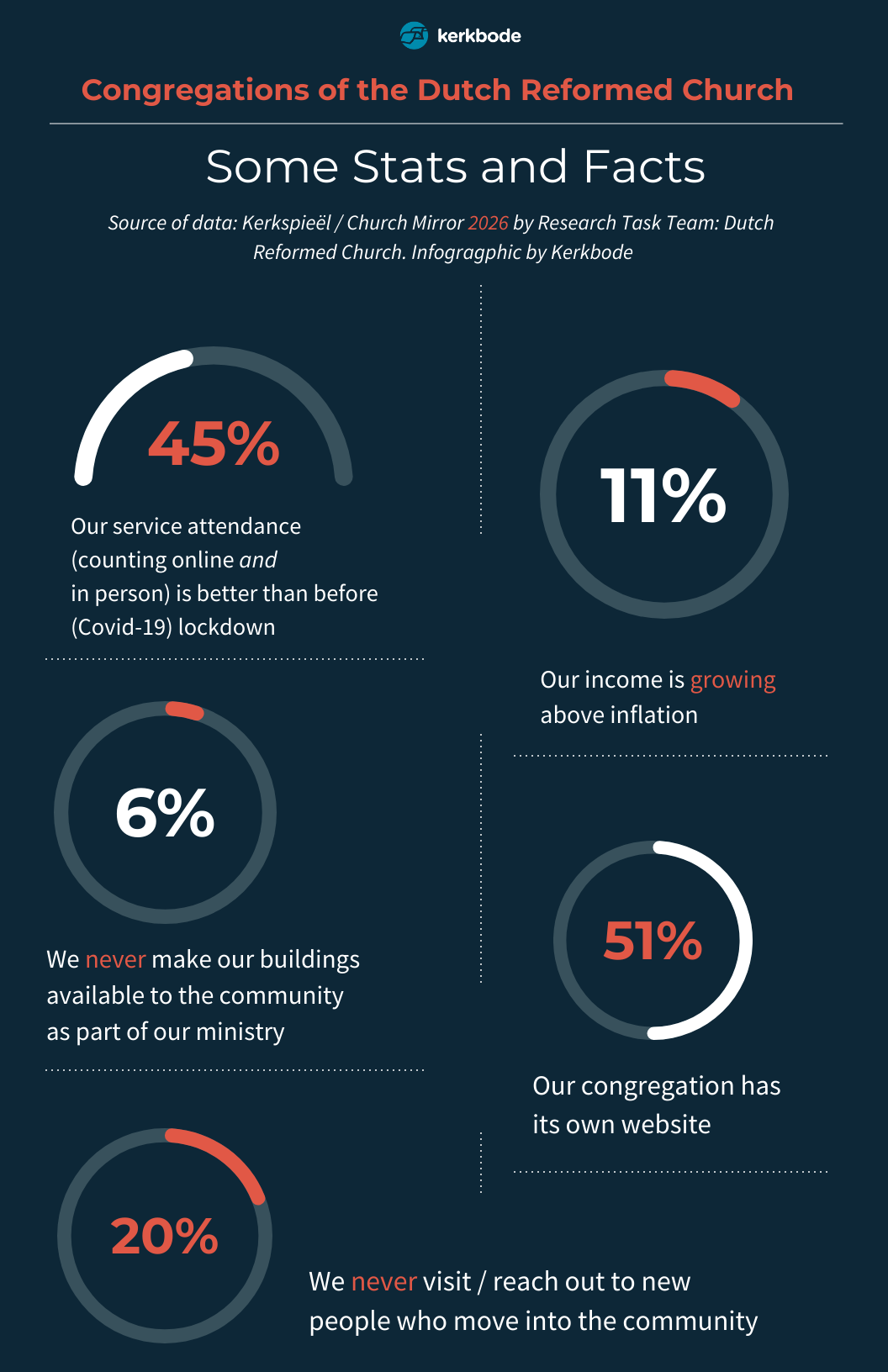
Church Mirror is published every four years. Risking the ire of theologians like Dallas Willard who warned against a fixation on routine church metrics (ABC – attendance, buildings, cash!) it starts exacytly there, but does expand its scope and line of questioning. It monitors income, attendance (virtual and otherwise) and creative use of buildings. It also looks at themes such as tech adoption, conception of hospitality, and the thing DRC congregations seem to somehow be simultaneously the most open to and the most defended against: healing its self-created racial division.
Back in 2021 Unisa professor Cobus van Wyngaard, who heads the research task team, co-authored an academic paper stating it plainly: ‘While the opening of church membership signified the first steps in rejecting apartheid, the discourse around community involvement has become the primary way the DRC negotiates its place within South Africa.” And, it has to be said, the latest survey data continues to conflate, confuse and to theologise the simple truth that reunification with the Uniting Reformed Church is moot.
The latest survey was sent to the roughly 1 000 remaining congregrations of the DRC and got a response rate of 65% on a 16 page questionnaire aimed directly at ministers or leaders in the church (as opposed to other surveys aimed at the experience of congregants). The results were made public in Wellington in the Western Cape during a bootcamp-styled event where a couple of ministers signed up to act as something akin to citizen journalists by adding to the reporting on the survey results.
But the answers in the data bring their own questions. Something that Bosman’s fellow researcher, dr Pieter van der Walt, acknowledges. He cites earlier research about mental wellbeing among ministers, where the data showed female ministers are doing worse than their male equivalents. “So, now we know, but what does that mean?” Van der Walt explained: “The questionnaire gives us indication of where further research is necessary.” And so the mission continues.
Schoeman is a journalist and editor of Kerkbode.
Dis vir my onrusbarend dat minder as twee derdes van gemeentes/predikante vraelyste voltooi het. Hierdie is nie ‘n ondersoek daar buite in die sekulere wereld waar response van minder as 10% dikwels die norm is nie. Hierdie is geteiken op spesifieke gehore wat die groei van die Ned Geref Kerk assesseer.